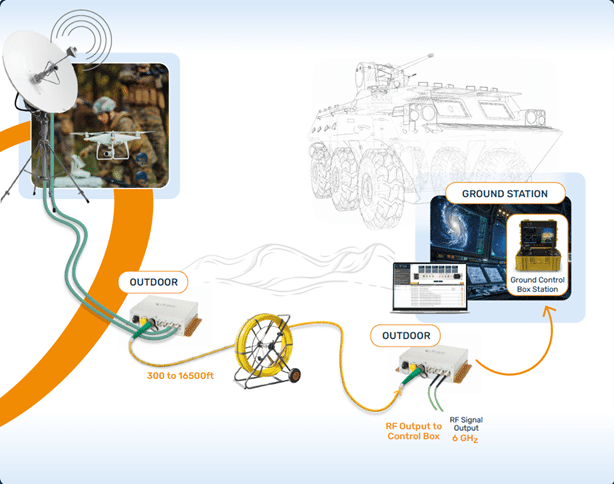


RF over Fiber for Ground Station Drone
In the rapidly developing field of unmanned aerial vehicles (UAVs) and drones, effective communication between the drone and ground control stations is critical. RFOptic’s RF over Fiber (RFoF) technology offers a robust solution for antenna remoting, allowing for improved range and coverage, signal integrity, operational safety and flexibility. These RFoF are bidirectional incorporating support for command and control uplink channels as well as HD video downlink.
What makes RF over Fiber superior to coax in ground station drone solutions?
RF over Fiber technology replaces coaxial cable which suffer from high loss and susceptibility to electromagnetic interference and weight. RFoF links provide low noise figure and gain, making them ideal for long-range communication. Additionally, the lightweight and compact nature of fiber optics facilitates deployment in remote locations and enable airborne remote antenna solutions where an auxiliary drone carries the remote antenna assembly which communicates with the primary drone. Such solutions allow ad-hock antenna remoting that can overcome terrain obstacles and increase coverage and range and insure operator safety.
Key characteristics for ground station drone applications
The system supports bidirectional communication for all drone signals, featuring a low-noise front end with 30dB gain in receive mode and a high-power transmitter for extended range. RFoF antenna remoting applications range from a few meters to many kilometers. These solutions are typically supplied in rugged AC or DC powered outdoor enclosures for durability but they are also offered in custom lightweight trays for airborne deployment. RFoF interfaces to the drone system may be hard wired or wireless supporting multiple controllers and drones/UAVs.
Frequency range & RF coverage
Designed to operate from 2GHz to 6GHz frequency range since most drones use dual band WIFI (2.4GHz for command and control and 5.8GHz for video downlink. Nevertheless, the RFoF system can be customized for other frequency ranges, accommodating up to 18GHz as may be necessary. This flexibility allows the system to cover any bandwidth used by commercial and defense UAV systems, thereby optimizing communication for various applications.
Ground station drone application & design
The RFoF technology is particularly beneficial for UAV applications, providing high dynamic range and bi-directional support for remote antenna setups. Distancing the antenna from the operator eliminates the operator risk due to targeting of the antenna emissions. The system can be deployed to bypass terrain obstacles and maintain line-of-sight RF communication with the drone/UAV. It maintains constant flight control signal connection while receiving status and video and reconnaissance data feed. The uplink channel ends with a power amplifier designed to meet the power source capabilities while the downlink channel includes an LNA to achieve good SNR at increased range.
Deployments of the RF over Fiber Drone/UAV system (examples)
RFoF remote antenna solutions for drones include a number of examples, the simplest of which is the stationary remote antenna which integrates a bidirectional RFoF terminal in a 1U removable rack mounted enclosure installed in the ground station van. The RFoF common (Tx/Rx) RF port is hard wired to a drone/UAV controller. The RFoF fiber cable leads out of the van to a nearby antenna tower onto which the remote RFoF terminal is installed and is attached to a directional antenna that communicates with a distant drone/UAV.
A different deployment has an RFoF bidirectional terminal installed in a SOD enclosure endowed with suitable antenna(s). It wirelessly communicates with a drone controller both in the control room. A single mode disposable fiber-optic spool is installed on the drone connected to the RFoF remote terminal that in-turn is connected to also the drone wirelessly. The drone is flown into a tunnel, a sewer pipe or over a hill to provide the needed reconnaissance.
Yet another example of such deployment involves a dangerous construction site where a remote operated crane is used to maneuver hazardous materials and where the crane RC has a limited range. The RFoF bi-directional link is outfitted in this case in two SOD enclosures and an armored fiber cable in-between. The RFoF system is wirelessly interfaced to the crane and is hard wired to the controller. This setup allows the operator to perform his duties and remain safely far away from the hazardous materials.
Conclusion
RFOptic’s RF over Fiber technology represents a transformative solution for UAV and drone communication, addressing the challenges of traditional coaxial systems. With enhanced range, reduced signal loss, and the integration of advanced monitoring capabilities, this system stands out as the ideal choice for engineers seeking reliable and efficient antenna remoting solutions in the evolving landscape of aerial technology.
Contact Us