


Standard RF Over Fiber (RFoF) links
Programmable, HSFDR, Ultra
RF over Fiber programmable family
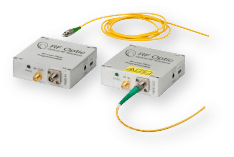
Our RF over Fiber programmable family consists of direct modulation RFoF solutions covering bandwidths from 1MHz to 2.5GHz, 3GHz, 4GHz, and 6GHz. Parameters are configurable through the configuration tool software. Remote Monitor & Control for enclosed modules is via an USB interface and includes diagnostic RF test of the Tx, Rx, and full RFoF end-to-end link test.
RFoF links are suitable solutions for any application limited by coaxial cable loss and where RF bandwidth limits performance.
Overview of our programmable RFoF links
| Product | Bands |
| RFoF 2.5GHz programmable RFoF links | Up to S band (1MHz up to 2.5GHz) |
| RFoF 2.5GHz for GPS programmable RFoF links | Up to S band (1MHz up to 2.5GHz) |
| RFoF 3.0GHz programmable RFoF links | Up to S band (1MHz up to 3GHz) |
| RFoF 4.0GHz programmable RFoF links | Up to S band (1MHz up to 4GHz) |
| RFoF 6.0GHz programmable RFoF links | Up to C band (1MHz up to 6GHz) |
| RFoF 8.0GHz programmable RFoF links | Up to C band (1MHz up to 8GHz) |
High SFDR series
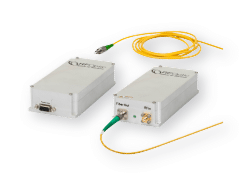
Our High Spurious Free Dynamic Range (SFDR) series of RFoF Transmitters & Receivers operate at bandwidths from 0.1GHz up to 67GHz.
They are typically used for applications such as DF/ELINT systems where strong jammers concurrent with weak signals of interest are present. Scenarios include antenna testing, radar, and communications system.
For your convenience, please find below an overview of the high frequency coverage of our RFoF products.
| RF over Fiber (RFoF) LN series | Bands |
| RFoF 12GHz LN HSFDR RFoF links | Up to X band (up to and including 12GHz) |
| RFoF 18GHz LN HSFDR RFoF links | Up to Ku band (up to and including 18GHz) |
| RFoF 20GHz LN HSFDR RFoF links | Up to K band (up to and including 20GHz) |
| RFoF 30GHz LN HSFDR RFoF links | Up to K band (up to and including 30GHz) |
| RFoF 40GHz LN HSFDR RFoF links | Up to Ka band (up to and including 40GHz) |
| RFoF 67GHz LN HSFDR RFoF links | Up to V band (up to and including 67GHz) |
| RF over Fiber (RFoF) Mini-Q series | Bands |
| RFoF 12GHz Mini-Q HSFDR RFoF links | Up to X band (up to and including 12GHz) |
| RFoF 18GHz Mini-Q HSFDR RFoF links | Up to Ku band (up to and including 18GHz) |
| RFoF 20GHz Mini-Q HSFDR RFoF links | Up to K band (up to and including 20GHz) |
A high SFDR solution simplifies signal conditioning requirements for separating true signals from undesired spurious. Options for High SFDR RF over Fiber links include a built-in pre-amplifier for the Tx module to improve the Noise Figure and increase the gain while it reduces the IP1dBc (Input power at 1dB gain compression). The Rx module can be configured with a built-in post-amplifier to increase the gain of the link and achieve higher signal level. Since RFOptic’s 12, 18, 20, 30, 40, and 67 GHz HSFDR solutions provide SFDR greater than 111 dB/Hz2/3, optional pre- or post-amplifiers may not be necessary.
ULTRA series
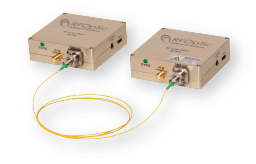
Our ULTRA series of low power and weight RFoF Transmitters & Receivers covers the 01.GHz up to 20GHz bands. These RFoF modules share the small dimensions of the RFoF Programmable Series and therefore can be installed in 2U high-density subsystems, accommodating up to 40 independent transmitters / receivers or 20 half bidirectional terminals.
| RF over Fiber (RFoF) ULTRA series | Bands |
| RFoF 12GHz ULTRA RFoF links | Up to X band (up to and including 12GHz) |
| RFoF 18GHz ULTRA RFoF links | Up to Ku band (up to and including 18GHz) |
| RFoF 20GHz ULTRA RFoF links | Up to K band (up to and including 20GHz) |
Bidirectional RF over Fiber (RFoF) link
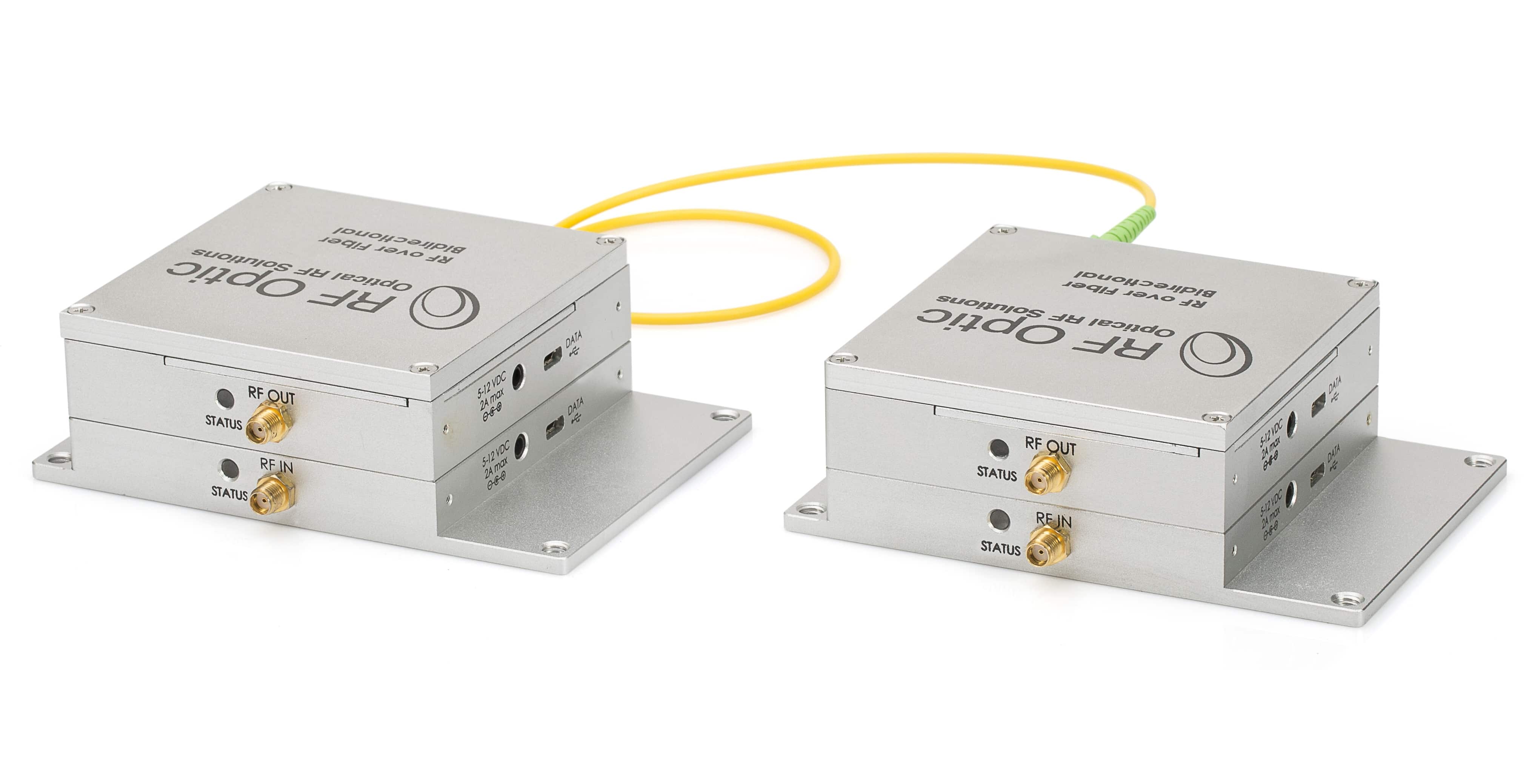
Our 6.0GHz bidirectional RF over Fiber link is an innovative compact 2-way transceiver. It is comprised of an uplink of Tx and Rx (at 1550nm) and a downlink. Our bidirectional RFoF programmable series includes 2.5GHz, 3GHz, and 4GHz product versions.
It is comprised of an uplink of Tx and Rx (at 1550nm) and a downlink of Tx and Rx at 1310nm. The transceiver employs WDM technology to allow it to use only one fiber link instead of two fibers for transmission over long distances. Each terminal contains an optical transmitter (Tx) that converts RF to an optical signal and an optical receiver unit that converts it back to the RF signal (Rx). The two terminals are connected through the customer’s single mode fiber to complete the bidirectional RFoF link.
| Bidirectional RFoF link | Bands |
| Programmable bidirectional RFoF link | Up to C band (up to and including 6GHz) |